Demand for oil is falling because supply cannot meet it, not because it is no longer required
By Sara Vakhshouri
The current oil market disruption represents the largest supply shock in modern history. Yet its most important implication is not simply higher prices, but a more fundamental shift in how energy systems function under stress.
What is happening is not a conventional demand slowdown driven by economic cycles, inflation or policy shifts. Nor is it primarily a story of energy transition, tariffs, OPEC supplies or demand-side management. Instead, the adjustment underway is being driven by a single, binding constraint: the inability to move physical supply through critical chokepoints.
Demand is not declining because it is no longer needed. It is being forced lower because it cannot be met, and not just due to higher prices alone. This is the illusion at the heart of today’s market. Supply may exist in aggregate. But when it cannot move, it ceases to function as supply.
A market at odds with itself
The current structure of the oil market reveals a deeper tension between price signals and physical realities.
Oil markets have historically balanced through price. Higher prices incentivise production, reduce consumption and restore equilibrium. That mechanism still operates, but it is no longer sufficient to explain current dynamics.
The clearest signal of this breakdown lies in the unprecedented divergence between physical and paper markets. Physical barrels are trading at a premium of $20–50/bl above front-month futures—an extreme level of paper-physical backwardation that reflects acute, immediate scarcity in deliverable supply.
This creates a market at odds with itself. On one hand, physical markets are signalling tightness and constraint. On the other, futures markets appear to be pricing a relatively rapid normalisation of flows, potentially linked to expectations of geopolitical de-escalation or the availability of inventory buffers.
The implication is that the physical market is pricing shortage, while the paper market is pricing resolution. This divergence suggests the constraint is accessibility and not the existence of supply. Even if oil is available somewhere in the system, it is not necessarily available where it is needed, in the form required, or within the timeframe demanded by the market.

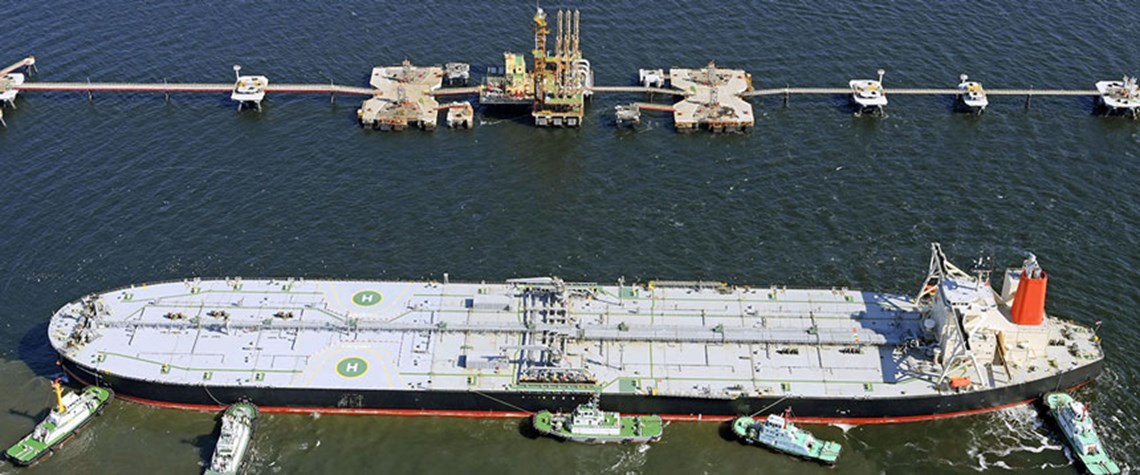
The last Japan-bound crude tanker to leave the Strait of Hormuz before its closure arrives in Tokyo Bay Markets
This raises a critical question: is the market underestimating the persistence of disruption? If the disruption to the flow of energy from the region is prolonged, the implications for both oil markets and the global economy could be significant.
In this context, the paper market may be priced to perfection, while the physical market reflects a more constrained reality.
Demand destruction as a function of access
The IEA has already revised its demand outlook downward, signalling consumption is adjusting in response to the shock. However, this is not a synchronised, global contraction. The demand destruction is uneven, fragmented and highly specific.
This reflects the underlying complexity of modern energy systems. Oil is not a homogeneous commodity. Crude grades differ, refined products serve distinct functions, and LNG, LPG and petrochemical feedstocks each operate within separate supply chains and infrastructure systems. These systems are not easily interchangeable. The Strait of Hormuz brings this reality into sharper focus. It is often framed as a chokepoint for ‘oil’, but in practice it is a conduit for a wide range of hydrocarbon molecules, each with distinct end-uses and substitution constraints.
Disruption to Hormuz therefore does not remove a single commodity from the market. It simultaneously constrains multiple, non-fungible molecules, each embedded in different industrial systems.
As a result, the disruption is not producing a unified demand response but a set of localised and sector-specific adjustments. Refiners facing constrained access to appropriate crude grades reduce throughput. Transport systems respond to shortages in specific fuels such as diesel or jet fuel rather than ‘oil’ in aggregate. Petrochemical producers adjust to disruptions in naphtha, condensates and LPG, while gas and electricity markets experience separate pressures linked to LNG routing, storage and the availability of alternative supplies.
Demand destruction, in this context, is not simply about consuming less energy. It is about the inability to access the specific molecules required to sustain economic activity.
Uneven exposure: The case of Japan
Japan offers a clear example of how these dynamics play out. At first glance, the Asian country appears highly vulnerable. Approximately 94% of its crude oil imports originate from the Middle East, much of it transiting the Strait of Hormuz. Yet its actual exposure to disruption is more differentiated.
Japan’s crude inventories are adequate to sustain supply through at least early next year, as emphasised by Prime Minister Sanae Takaichi. This is also the case for domestic refined product supply. According to the Institute of Energy Economics, Japan, gasoline, diesel, and jet fuel are not expected to face shortages, as domestic refining capacity is sufficient to meet national demand.
Japan’s LNG exposure to Hormuz is relatively limited—around 6%—with diversified supplier agreements with Australia and Malaysia, although storage capacity covers only about three weeks of demand. The power sector also provides an additional buffer. Japan’s power mix includes coal-fired generation, nuclear energy and renewables alongside gas-fired plants, which account for roughly one-third of electricity generation, allowing for a degree of flexibility in response to LNG disruptions. LPG imports are more diversified, with significant volumes sourced from North America. Meanwhile, strong domestic refining capacity supports stable supply of transport fuels.
Supply may exist. But if it cannot move, it cannot serve demand
However, vulnerabilities persist. Naphtha, a key feedstock for petrochemical production, remains significantly exposed, with roughly 40% dependence on Middle Eastern supply. Downstream chemical industries therefore face more acute constraints, with limited substitution options. Many chemical products are produced from naphtha. To ensure stable production of medical supplies, the Japanese government has already set up a ministerial-level task force to prioritise the supply of naphtha for essential production.
The result is a system that is resilient in aggregate, but uneven in detail. Some segments remain stable, while others are directly impacted.
Not all countries have Japan’s level of diversification and built-in resilience, and outcomes reflect differing levels of exposure and overall energy security strength. This is the defining characteristic of the current market: demand destruction is not uniform. It is sector-specific, molecule-specific and geography-specific.
Inventories: A cushion, not a solution
In this environment, inventories play an essential role. Strategic petroleum reserves and commercial stocks provide a buffer that can smooth short-term imbalances and stabilise market sentiment. But their function is often overstated.

Inventories do not generate new supply and cannot resolve logistical constraints. Nor can they substitute for sustained disruptions to critical transit routes. Instead, they provide time. They allow markets to adjust, to reroute flows and to absorb shocks in the short term. But they do not address the underlying issue of constrained accessibility.
Their availability is also uneven. Inventories are heavily concentrated in OECD countries and China, and their release is shaped by national policy decisions and strategic priorities. As a result, access is not universal, and many countries cannot rely on these buffers in the same way. In this sense, inventories act as a cushion to the market, but they are not a silver bullet.
Saudi East-West Pipeline: Critical to energy security
Saudi Arabia’s position highlights both the strengths and limitations of energy security strategies in the current geopolitical conflict.
The Kingdom has invested heavily in logistical diversification, most notably through the East-West pipeline, which has become a critical asset for global energy security in the current Iran war. By allowing crude exports to bypass the Strait of Hormuz and reach the Red Sea, this infrastructure is now actively supporting flows and reinforcing energy security. However, its capacity also highlights a key limitation: alternative routes can mitigate disruption, but they cannot fully replace the scale of volumes typically transiting Hormuz.
Saudi Arabia has also demonstrated an ability to rapidly restore production following wartime disruptions, reinforcing its role as a stabilising force in global markets. In the current environment, this responsiveness remains central to market confidence, even as physical constraints persist.
Alternative routes have finite capacity relative to total export volumes. Red Sea exports introduce new geopolitical risks, including exposure to disruptions to Bab el-Mandeb transit. Infrastructure remains vulnerable to targeted attacks.
Diversification reduces risk. It does not eliminate it. Even the most resilient producers remain embedded in a system where chokepoints and logistics continue to define outcomes.
Rethinking energy security
The current crisis challenges conventional definitions of energy security. For decades, energy security has been understood primarily in terms of supply availability. The assumption was that if sufficient resources existed, markets would function.
That assumption no longer holds. Supply may exist. But if it cannot move, it cannot serve demand. The defining constraint is no longer the volume of supply, but the reliability of access.
This is the illusion of supply. And it leads to a broader conclusion: energy security is no longer about how much supply exists—it is about how reliably that supply can be accessed.
•Dr. Sara Vakhshouri is a faculty member, Walsh School of Foreign Service, Georgetown University, faculty member and chair of Center for Energy Security and Diplomacy at the Institute of World Politics. She is also founder and president of SVB Energy International and senior energy fellow at Oxford Institute for Energy Studies and Canadian Global Affairs Institute.
Source: Petroleum Economist