By Adeola Oguntuase
The appointment of former Ekiti State Governor, Ayodele Fayose, as Chairman of the Board of the Rural Electrification Agency (REA) presents him with an opportunity to demonstrate that his political experience can translate into measurable development results. President Bola Tinubu’s decision places Fayose at the helm of a federal agency whose mandate directly affects millions of Nigerians living in communities where electricity remains a distant promise.
Having served as governor of Ekiti State for two terms, he has had considerable exposure to the challenges of governance, infrastructure and public expectations. His new responsibility, therefore, should not be treated merely as another political appointment. It should be seen as another opportunity for him to build a legacy around something Nigerians can see, measure and feel.
Fayose recently attributed Nigeria’s population challenge partly to poor electricity supply, suggesting that inadequate power has contributed to the country’s population growth. While there is an understandable argument that reliable electricity can influence economic development, urbanisation, access to education, healthcare and family welfare, the claim should be treated with caution.

•Chief Ayo Fayose (left) and others taking oath of office during the inauguration of the Board of the Rural Electrification Agency (REA) by the Minister of Power in Abuja, on Friday.
Nigeria’s electricity crisis is hardly a recent phenomenon because the country struggled with inadequate and unreliable electricity long before the current population explosion. Indeed, the roots of Nigeria’s power problems stretch back decades, including the colonial and immediate post-independence periods. It would therefore be an oversimplification to suggest that poor electricity supply is responsible for Nigeria’s overpopulation.
Population growth is shaped by a much broader combination of factors, including fertility rates, healthcare, education, poverty, cultural practices, age structure and access to reproductive health services. Electricity is certainly part of the development equation, but it cannot reasonably carry the entire explanation.
Rather than spending too much time explaining why Nigeria has remained underdeveloped, he now has an opportunity to help change one of the conditions contributing to that underdevelopment.
The REA is not an agency where success should be measured by the number of speeches delivered, conferences attended or promises announced. Its success should ultimately be visible in communities.
Nigerians want to see rural homes connected to dependable electricity. They want health centres with functioning power, schools where students can study after sunset, farmers able to preserve agricultural produce, small businesses operating without depending entirely on petrol and diesel generators, and rural communities gaining access to clean and affordable energy.
Fayose should therefore talk less and act more. His experience as a two-term governor means Nigerians can reasonably expect him to understand the difference between political messaging and actual delivery. At REA, the benchmark should be simple: what changed because Fayose was there?

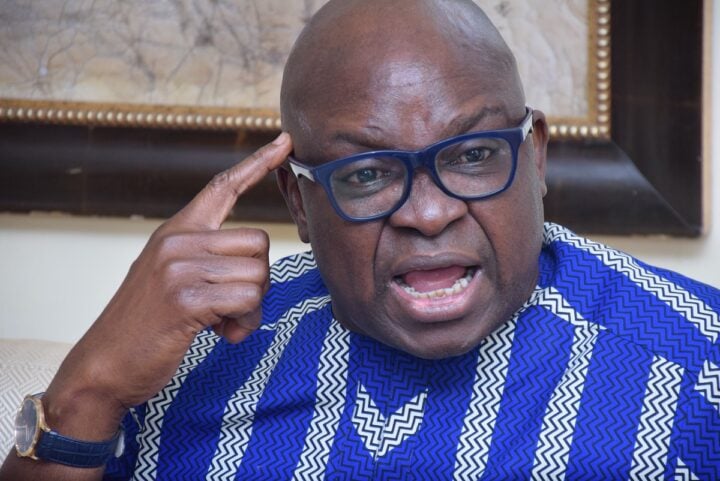
•Fayose
The agency already has programmes and initiatives aimed at expanding electricity access through grid extension, mini-grids and other decentralised solutions. Fayose's responsibility as chairman should be to provide effective oversight, demand accountability, support competent management and ensure that projects reach the people for whom they were designed.
He should also insist on transparency in the selection and execution of rural electrification projects. Communities should not have to lobby endlessly before being considered for electricity projects, while politically connected areas receive disproportionate attention.
There is also an opportunity to champion a more aggressive deployment of renewable energy in remote communities where extending the national grid may be technically difficult or economically expensive. Solar mini-grids and standalone systems can provide immediate benefits where conventional grid expansion may take years.
Fayose should understand that this appointment is bigger than Fayose the politician. It is about Fayose the public servant being given another platform to prove his capacity.
Nigerians have heard enough explanations about why electricity remains a problem. What they need now are results.
The former governor has another chance to write a different chapter of his public-service story. If he can help transform rural electrification from a cycle of promises into a programme of visible, functioning and sustainable electricity projects, his tenure at REA could become one of the most consequential assignments of his public career.
The time for grandstanding is over. The rural communities are waiting. Let the results speak.
•Adeola sent in this piece from Ilawe Ekiti