By Oke Peter
For most Nigerians, a landfill is simply a mountain of waste — a sprawling dump site filled with household refuse, discarded plastics, food remnants and industrial scraps. But in Sweden, some of these same waste dumps have become valuable energy assets, generating electricity, heating homes and reducing greenhouse gas emissions. It sounds like an energy oddity: turning rubbish into power.
Yet it is a reality that has helped Sweden emerge as one of the world's leading waste-to-energy nations. The Scandinavian country has become so efficient at converting waste into energy that it has, at various times, imported waste from neighbouring countries to feed its power plants.
As Nigeria continues to grapple with electricity shortages, rising energy costs and mounting waste management challenges, a question is beginning to attract attention among energy experts and environmentalists: could the country's overflowing landfills become a new source of electricity?
The answer may lie beneath the heaps of waste at Lagos' Olusosun landfill, Oko Filling in Igando, Asunle landfill in Ibadan and dozens of major dumpsites scattered across the country.
Sweden's waste-to-energy success story
Sweden's waste-to-energy industry is built on a simple principle: waste should be viewed as a resource rather than a disposal problem.
According to the Swedish Waste Management Association (Avfall Sverige), less than one percent of Sweden's household waste now ends up in landfills. Instead, waste is recycled, converted into biogas or used in waste-to-energy plants to generate electricity and district heating.

Source: Swedish Waste Management Association ((Avfall Sverige)
Among the country's most prominent facilities is the Högdalenverket Waste-to-Energy Plant in Stockholm, operated by Stockholm Exergi. The facility processes approximately 700,000 tonnes of waste annually and supplies electricity and district heating to a significant portion of the city. Stockholm Exergi reports that its waste-to-energy operations contribute more than 2,000 gigawatt-hours (GWh) of energy annually.
Another major player is Fortum's Brista Combined Heat and Power Plant near Stockholm. The Brista 2 facility converts roughly 240,000 tonnes of municipal waste each year into about 20 megawatts (MW) of electricity and approximately 60 MW of thermal energy used for district heating.
Swedish environmental services company Ragn-Sells has also pioneered landfill gas recovery projects, capturing methane emissions from landfill sites and converting them into usable energy. Similar initiatives are operated by regional utilities such as Sysav and Tekniska Verken.
Together, these projects form part of a circular economy where waste is continuously recycled into economic value.
The hidden fuel beneath every landfill
The key to landfill electricity generation is methane. When organic materials such as food waste, paper, agricultural residue and vegetation decompose in oxygen-deprived conditions, they produce landfill gas. Methane typically accounts for between 45 and 60 percent of this gas mixture.
According to the United States Environmental Protection Agency (EPA), landfill gas can be captured through a network of underground wells and piping systems before being cleaned and used to fuel engines, turbines or generators.
The process offers a dual benefit. First, it generates electricity from a resource that would otherwise be wasted. Second, it prevents methane from escaping into the atmosphere. The United Nations Environment Programme (UNEP) identifies methane as one of the most potent greenhouse gases, with a warming effect significantly higher than carbon dioxide over a 20-year period. In other words, every cubic metre of methane converted into electricity is both an energy gain and an environmental victory.
Nigeria's untapped landfill energy potential
Nigeria may possess one of Africa's largest untapped landfill-gas resources. Lagos alone generates an estimated 13,000 to 15,000 tonnes of solid waste daily, according to figures from the Lagos Waste Management Authority (LAWMA).

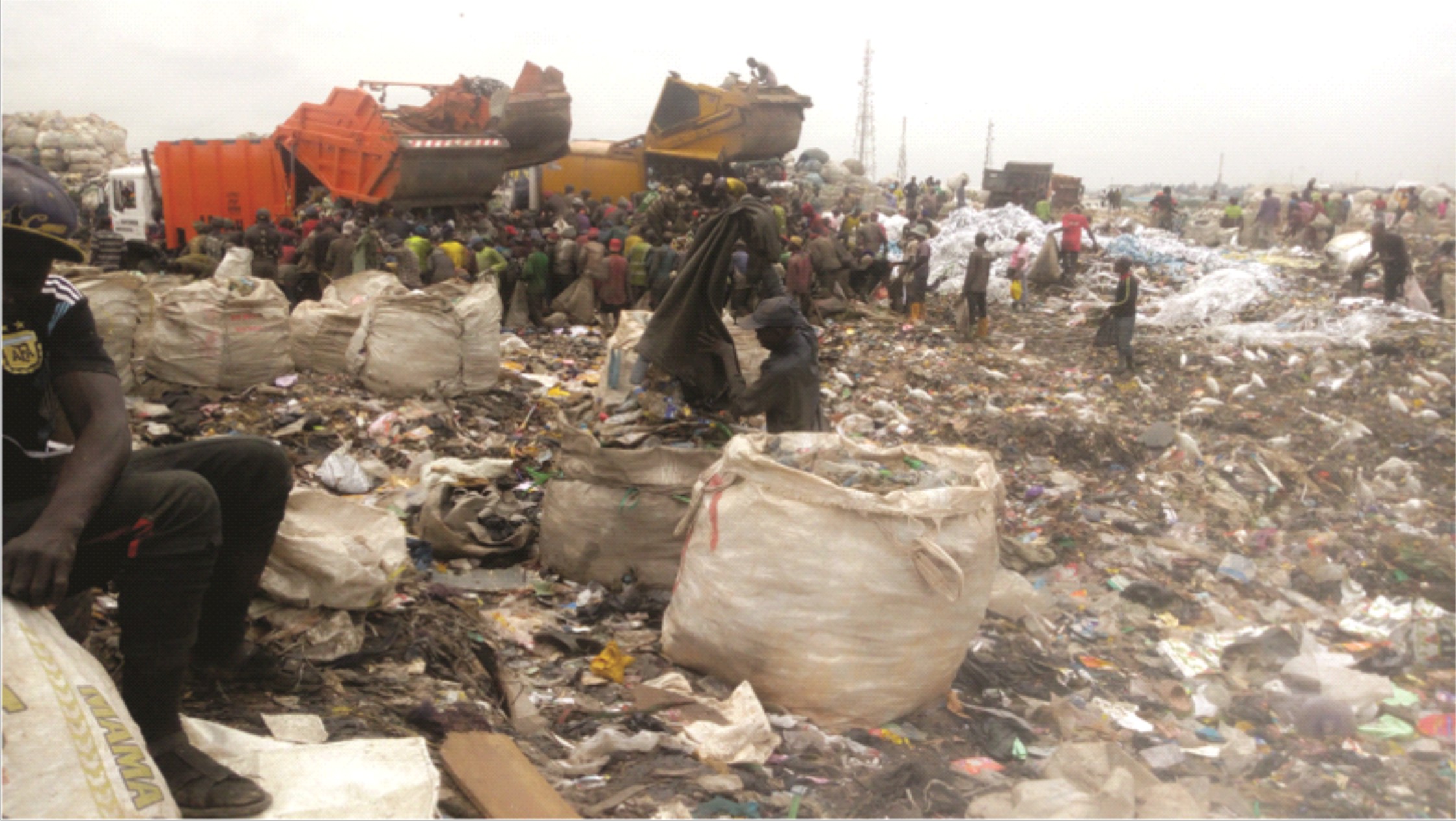
•Scavengers at Olusosun landfill, Ojota, Lagos
A significant proportion of this waste eventually finds its way to large disposal sites, particularly Olusosun landfill at Ojota, one of Africa's largest dumpsites.
For decades, Olusosun has been viewed primarily as a waste management challenge. However, energy experts increasingly see something else beneath its surface: a vast methane reservoir. As organic waste decomposes underground, methane accumulates continuously. In countries such as Sweden, Germany, the United States and the United Kingdom, similar landfill gas is routinely captured and converted into electricity.
Beyond Olusosun, other sites with potential include:
•Oko Filling Landfill, Igando, Lagos;
•Asunle Landfill, Ibadan, Oyo State;
•Solous Landfill, Lagos;
•Gosa Dumpsite, Abuja;
•Eneka Dumpsite, Port Harcourt; and
•Major municipal landfills in Kano, Aba, Benin City and Onitsha.
Collectively, these sites contain millions of tonnes of waste capable of producing methane over several decades.
How much electricity could be generated?
Determining Nigeria's exact landfill-gas power potential would require detailed feasibility studies. However, international experience offers useful insights. According to the International Renewable Energy Agency (IRENA), landfill-gas power projects globally range from small 1 MW facilities to installations exceeding 50 MW depending on waste volume and gas quality. A well-managed landfill receiving several thousand tonnes of waste daily can potentially support electricity generation ranging from 5 MW to 20 MW.
If major landfills in Lagos, Abuja, Port Harcourt and Ibadan were equipped with gas collection systems, Nigeria could potentially create a network of distributed renewable energy projects capable of supplying nearby communities, industrial estates and public infrastructure. While landfill gas alone cannot solve Nigeria's electricity deficit, it could become an important component of a diversified energy mix.
What Nigeria can learn from Sweden
The Swedish model offers several important lessons. Sweden transformed its waste sector by recognising that rubbish has economic value. Nigerian policymakers still largely focus on waste disposal rather than waste utilisation.
Investment in collection infrastructure is critical
Landfill gas cannot be harvested without proper gas wells, collection pipes, treatment systems and generation equipment. Public-private partnerships drive success
Many Swedish waste-to-energy projects involve cooperation between municipalities and private energy companies. Similar partnerships could help Nigeria attract investment into landfill-gas projects.
Regulation matters
Strict environmental regulations in Sweden discourage uncontrolled dumping and encourage methane recovery. Nigeria's regulatory framework could be strengthened to support similar outcomes.
Better waste sorting improves efficiency
Separating organic waste from recyclable materials increases methane production efficiency and enhances the economics of landfill-gas projects.
Is landfill electricity sustainable?
Critics often argue that waste-to-energy systems still generate carbon emissions and should not replace recycling programmes. The criticism is valid. However, experts generally agree that capturing methane from existing landfills is significantly more environmentally responsible than allowing the gas to escape into the atmosphere. The World Bank has repeatedly highlighted landfill-gas recovery as an effective climate mitigation strategy, particularly in developing economies where waste management infrastructure remains inadequate. In Nigeria's case, the environmental benefits could be substantial. Capturing methane would reduce greenhouse gas emissions, lower the risk of landfill fires and create a new source of renewable electricity.
The power plant hidden beneath nigeria's trash
At first glance, the idea seems improbable. A landfill is not the place most people would look for answers to an energy crisis. Yet Sweden's experience demonstrates that yesterday's waste can become tomorrow's electricity.

•An aerial view of Olusosun landfill
For Nigeria, the opportunity is especially compelling because it addresses two challenges simultaneously: waste management and power generation.
The methane already exists beneath Olusosun, Oko Filling, Asunle and numerous other landfill sites across the country. The technology to capture and convert it into electricity is neither experimental nor unproven. It is already being deployed successfully in Europe, North America and parts of Asia.
What remains uncertain is whether Nigeria is prepared to view its waste differently. If Sweden can transform garbage into gigawatts, Nigeria's next renewable energy frontier may not be in a gas field, hydro dam or solar farm.
It may be buried beneath a landfill.
Sources: Stockholm Exergi; Fortum; Avfall Sverige; IRENA; U.S. EPA; UNEP; World Bank (What a Waste 2.0); LAWMA; ISWA.